What it checks, and what it catches
Two jobs running quietly all the time: read the situation around a payment, and read the messages that lead people into one.
Five things it weighs before money moves
None of them means fraud on its own. It is the combination that tells the story.
-
01
Who is receiving it
RecipientWhether you have paid this person before, and whether anyone has already reported the ID as a scam.
-
02
Whether the amount fits you
AmountMeasured against how you normally pay, not a fixed limit. Your ordinary is the baseline.
-
03
Whether a call is connected
Call stateAlmost nobody is walked through a genuine payment by a stranger on the phone. Almost every victim is.
-
04
What recently arrived
MessagesA threatening or urgent message tied to this same recipient turns a mild concern into a serious one.
-
05
How you got to the payment
RouteA code you scanned or a link you tapped carries more risk than an ID you typed in yourself.
Use cases
Fraud messages are not creative. The same six stories get recycled because they work. Pick one to see how WallUPI reads it, and compare it with the genuine message it imitates.
The fake KYC deadline
A text says your account is frozen until you “update KYC” through a link, usually with a small fee. Minutes later someone calls to walk you through it.
- The text is scored on your phone the moment it lands
- Its sender is remembered against their number
- Paying that number later brings the message straight back up
- Message analysisOn-device
- Recipient linkSender tied to payee
URGENT: Your bank account has been BLOCKED due to KYC verification expired. Update KYC immediately by clicking here: http://fake-bank.xyz/kyc. Send Rs.99 for instant verification.
Your account XX1234 has been credited with Rs.1500.00 on 01-04-2026.
Both messages and both readings are taken from the demo app.
The prize you have to pay for
A win you never entered for: a lottery, a lucky draw, a refund. Collecting it always starts with you sending money first.
- Reward language next to a payment demand is caught together
- The message is marked high risk in your inbox
- A transfer to that number starts from a raised reading
- Message analysisOn-device
- Recipient linkSender tied to payee
Congratulations!!! You have WON a LOTTERY prize of Rs.50,00,000! To claim your reward, send Rs.5000 to…
Rs.25 cashback has been credited to your wallet for your last bill payment. No action needed.
Scam message and reading from the demo app. The genuine message is illustrative.
Read me the code we just sent
Someone posing as your bank or a delivery agent asks for the one-time code that just arrived. That code is the key to your account.
- A request for a code is treated as high risk on its own
- Paying while that call is still connected raises it further
- The warning names the rule: nobody genuine ever asks
- Message analysisOn-device
- Call stateIs a call connected
Dear customer, a wrong debit was made to your account. To reverse it, share the 6-digit code we just sent with our officer on the call.
482913 is your OTP to log in. Valid for 5 minutes. Never share it with anyone, including bank staff.
Illustrative example.
The link dressed as someone you trust
A parcel on hold, a blocked card, a pending refund, each with a link to a page built to capture whatever you type into it.
- Suspicious links are spotted inside the text
- A deadline wrapped around the link adds weight
- The message is flagged before you ever tap it
- Message analysisOn-device
- Inbox scanRuns when you open it
Your parcel is on hold due to an incomplete address. Update within 12 hrs or it will be returned: http://parcel-redeliver.co/upd
Your order has shipped and will arrive on Thursday. Track it any time in the app.
Illustrative example.
A familiar name on a new number
Someone borrows the identity of a friend or relative, then asks for an urgent transfer before you can check with the real person.
- The number is nobody you have paid before
- An urgent money request from it adds weight
- The payment screen says plainly: this is a new recipient
- Recipient historyPaid before or not
- Message analysisOn-device
Hi it’s me, my old phone broke so this is my new number. Need ₹8,000 urgently for a hospital bill, will return tonight. Please send to this UPI.
Dinner was great. Your share is ₹640, pay whenever.
Illustrative example.
“Approve this to receive money”
A buyer or an agent says they are sending you money and you only need to approve. Approving pays them, not you.
- WallUPI reads the direction of the request, not its wording
- Money leaving when you were told it was arriving is flagged
- The warning says it outright: your PIN never receives money
- Direction checkMoney in or out
- Recipient historyPaid before or not
Sending ₹5,000 for your sofa. Approve the request and enter your UPI PIN to receive the payment.
₹5,000 received from Rahul into your account XX1234. No action needed.
Illustrative example.
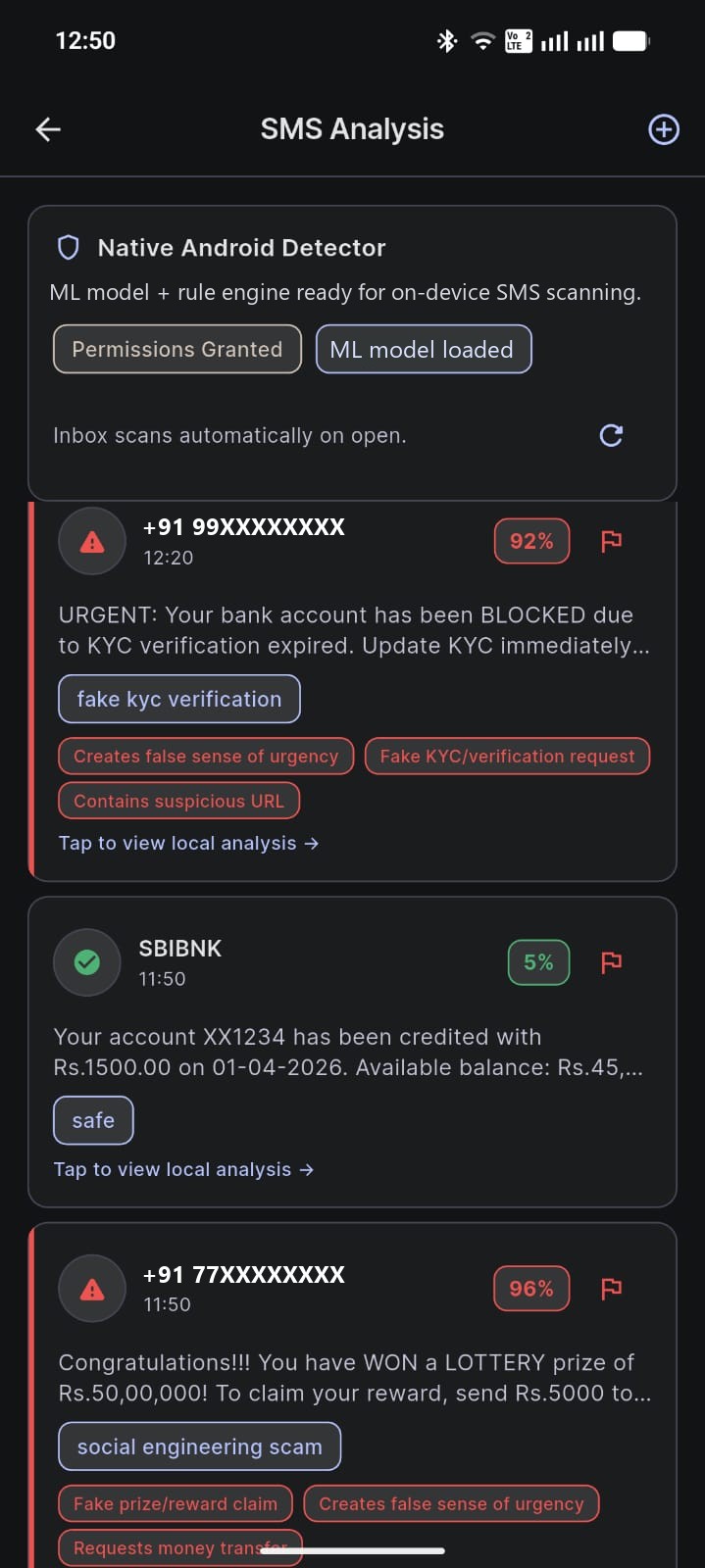
Your whole inbox, sorted by risk
Scam messages sit in the same list as your real bank alerts, written to look identical. WallUPI reads through them on the phone and marks the difference, so the dangerous ones stop blending in.
- 5%A genuine credit alert from your bank passes through unmarked.
- 92%A blocked-account demand with a fake link is flagged, reasons attached.
- 96%A lottery win that asks for a fee first is flagged the same way.
One report protects everyone after you
Scammers reuse the same IDs until they stop working. Reporting one is the fastest way to make it stop working sooner.
From one tap to a warning someone else sees
only
agree
payment
- What is shared
- The scam ID, and nothing else
- Never attached
- Your name, your number, the amount, or what you were paying for
- One wrong flag
- Cannot condemn anyone. Reports only count together
Try it against a real scam script
The demo includes the scam messages above, so you can watch the check run instead of taking our word for it.